
Keep mass, liquid volume, scale markings and biological activity separate.
HowToPeptide learning guide · Updated October 22, 2026
Identify the printed scale first
Read the syringe label and its calibration before interpreting any marking. A U-100 insulin scale has 100 scale units per mL. Other syringes may show mL directly or use a different calibration. A number taken from one scale cannot be transferred without checking what it represents.
Compare capacity and graduation
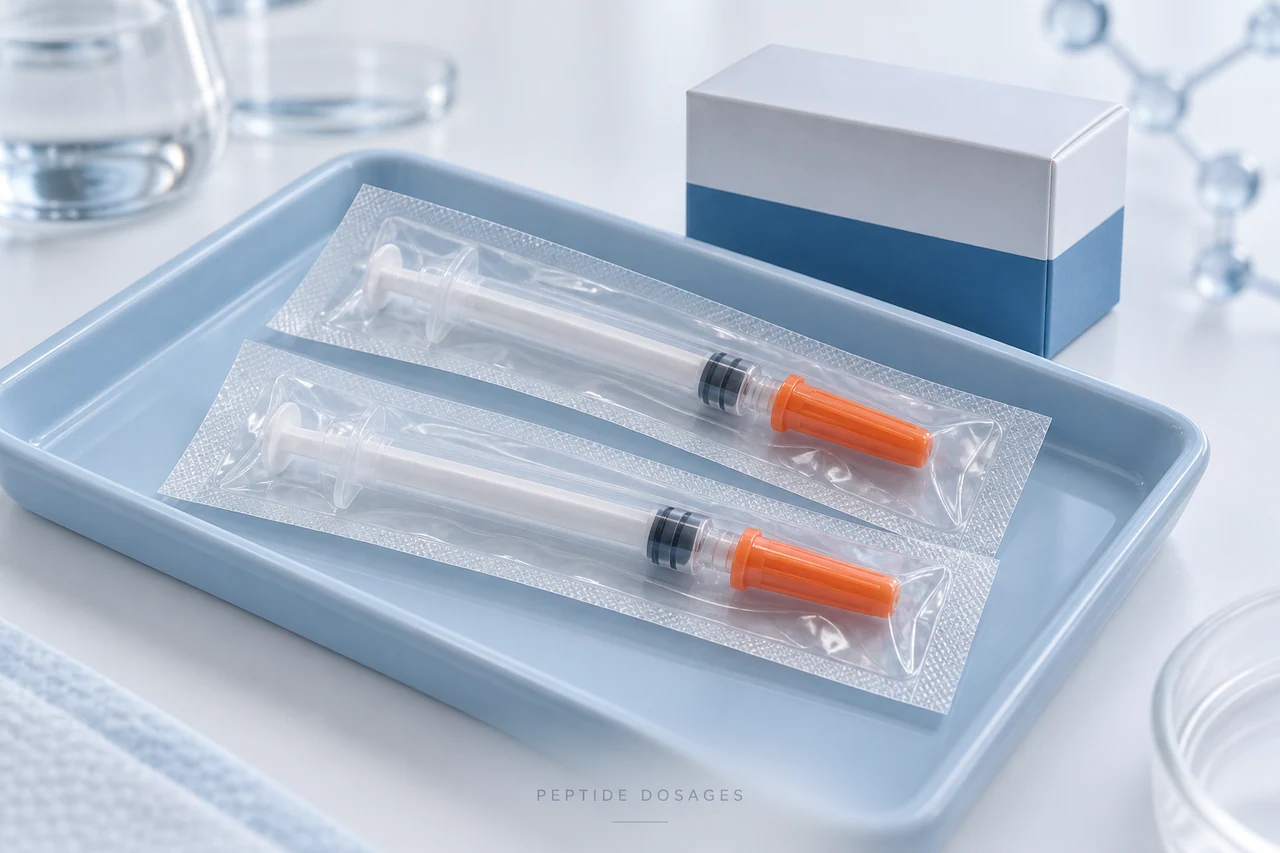
Capacity is the maximum volume a syringe holds; graduation describes the spacing between markings. Two syringes can have different capacities and different smallest intervals. A calculation may produce a volume that cannot be measured accurately on the available scale. Ask an appropriate professional about the suitable device.
Understand the U-100 relationship
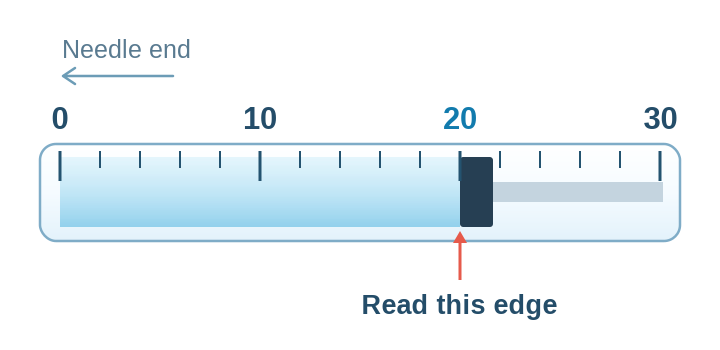
For the U-100 calibration only: 100 units = 1 mL, 50 = 0.5 mL, 10 = 0.1 mL, and 1 = 0.01 mL. This is a volume relationship. It does not mean that every compound has the same mass per marking.

Keep the four quantities distinct
Milligrams and micrograms describe mass. Millilitres describe volume. Syringe markings represent volume according to a scale. International Units describe substance-specific biological activity. One mg equals 1,000 mcg, but there is no general conversion from IU to mg across different substances.

Work through an example
A label stating 5 mg describes the total mass in a vial. If the final solution volume is 2 mL, its concentration is 2.5 mg/mL, or 2,500 mcg/mL. An example quantity of 100 mcg would occupy 0.04 mL. These figures explain dimensions and arithmetic; they do not choose a clinical dose.

| Mass | Final volume | Concentration |
|---|---|---|
| 5 mg | 1 mL | 5 mg/mL |
| 5 mg | 2 mL | 2.5 mg/mL |
| 5 mg | 5 mL | 1 mg/mL |
Use a compact conversion table
At 2,500 mcg/mL, 0.04 mL contains 100 mcg, 0.08 mL contains 200 mcg, and 0.10 mL contains 250 mcg. The corresponding U-100 markings are 4, 8 and 10. The concentration assumption belongs with this table; without it the mass values cannot be reused.

Recognize common conversion mistakes
Watch for a missed factor of 1,000 between mg and mcg, a decimal-place error, or a syringe marking treated as a mass unit. FDA has reported substantial errors involving compounded semaglutide conversions. Read back both the amount and its unit when reviewing a calculation. See FDA’s alert.

Device choice belongs in the clinical context
Needle gauge, needle length and syringe capacity are separate properties. They are chosen for the product, route and person, not from a general peptide rule. Use the device and technique specified by the responsible clinician or pharmacist and the product instructions.
Check the result independently
Write the source mass, final volume, resulting concentration, intended amount and calculated volume. Confirm that units cancel correctly. Then verify the scale conversion. If a value is beyond the device capacity or between unmeasurable graduations, resolve that issue rather than rounding casually.
Continue with the calculator
Use the calculator to check a dimensional example and compare it with your handwritten arithmetic. A correct calculation does not establish that a dose is medically appropriate or that a product is suitable for administration.